Balintore Castle can turn up in the "funniest" of places. I am indebted to an eagle-eyed friend of Balintore called Paul, for this latest sighting. The castle appears briefly 17 minutes and 30 seconds into the video of Alan Partridge's latest comedy tour "Stratagem" which is currently bundled for free on Amazon Prime.
The image is from a long time ago, possibly around the time I purchased the castle, judging from the size of the yew trees in front of the building. I trimmed the tops, and then removed them when they subsequently died. And they say you can't kill yew! :-)
Apart from Steve Coogan, I think I can identify one other member of the shooting party. Can anyone else supply any names?
The question of course is whether the shoot gathering knew about the comedy interloper, and indeed whether he introduced himself as Steve or Alan. :-)
Sometimes, Facebook's reminder of historic postings gives you a new perspective on a narrative, perhaps even that it might be blog-worthy. :-)
On the 8th January 2016, I visited UK Architectural Heritage: a veritable treasure trove of a reclaim yard in Herefordshire. I was picking up a fossil marble fireplace I had bought on eBay. Incidentally this fireplace was only installed last year - 6 years later!
Naturally, I had a look around the yard. One of the many items I regretted I could not afford were these lovely gates from Kensington Gardens.
gates at reclaim yard
On the 24th January 2016, I watched the film "Pan" (2015) and spotted the very same gates:
gates in movie "Pan" (2015)
Wowzers! Had these gates really been removed from Kensington Gardens in the last year? I did some online detective work, and discovered the actual gates for Kensington Gardens are very different and even grander. The UK Architectural Heritage website revealed that the gates were genuine period gates, that had "KENSINGTON GARDENS" added to turn them into a film prop. Mystery solved!
The coincidence that I should be watching the film a few weeks later, and the fact I instantly recognised the gates are both astonishing to me. The Balintore connection is that J.M.Barrie, who wrote "Peter Pan", visited Balintore Castle!
Already this winter, the snow has advanced and receded at the castle a number of times. For the fortnight up to my return to the castle on the 18th December, the landscape had been held in a deep-freeze state of Narnia-esque beauty. Just two days later the snow had all gone. Snow returned over the festive period, and my friends and I went for a daily walk in these conditions, while it was light to make the most of the short days.
During these walks, any exposed colour would stand out sharply, and one's eye would be drawn to this previously unobserved delight. One such are these red lichen growths. Can anyone identify? On enlarging the photo, I spotted the red "crusty" lichen is growing on top of the green "leafy" lichen. It is known that the lichen is a symbiotic relationship between an algae and a fungus. It is not without the realms of possibility, therefore, that different lichen species could be symbiotic either in whole or in part.
red lichen
During this second cold snap the temperature hovered around zero, sometimes above; sometimes below: perfect conditions for slow crystal growth. There were white lakes of crystals in fields glinting in the sunshine. I have never seen Jack Frost being so masterful before, even down to this crystal growth on Balintore's east drive, which I initially thought was the imprint of a leaf:
Jack Frost's finest in microcosm
While I was driving through Glen Quharity, I had one of those moments: the land was totally covered in snow, the mist had come down so even the air was in white-out. Above me two buzzards were circling, presumably looking out for small mammals breaking cover. Their forms were deeply etched in black on a white ground. It was elemental.
welcome to the annual Christmas blog entry! 2022 has been quite a year for most people as we distance ourselves from Covid, and this is equally true for everyone involved with Balintore Castle.
The restoration work has continued, but my personal involvement is very limited in terms of time as I am working full time for the UK Meteorological Office. I do my best to attend to "castle admin" in the evenings. This shortage of time explains the limited blog entries: 28 this year compared to a record 56 last year. Far too much time has been taken up attending to the unnecessary problems created by Angus Council.
My builder Gregor is still doing good work at Balintore, but he is now moonlighting part time at another architecturally impressive Victorian shooting lodge in Glen Isla, called Knockshannoch. Knockshannoch is just 6 miles from Balintore. As Gregor has been working for me for ten years, I understand that a little bit of a change is good for him so I do my best not to pout too much. :-)
One of the highlights of this year, was a guided tour round Knockshannoch by the new owners. They also have a huge restoration project ahead of them, though not quite as daunting a one as Balintore. The building has very definitely gone into the right hands, as the couple have an understanding and appreciation of the architecture that means they will do the very best by the building.
Strangely enough, I thought my days of seeing other restoration projects were over, but over the course of the year I was invited to see Park Hall Manor outside Manchester, Llwyn Celyn in South Wales and Gwrych Castle in North Wales. All these visits got me very excited and enthusiastic, which is confirmation that despite the enormous hardships involved, Balintore is the right path for me. Park Hall Manor and Knockshannoch are private residences, so naturally I am discreet and did not blog about these.
My Belgian friend and friend of Balintore, Karel came to visit in the autumn. We decided to turn up on spec for lunch at the Fife Arms Hotel in Braemar. Unfortunately, they were fully booked, but a staff member said if we could wait an hour, they could fit us in. An hour was just the right amount of time to see the flowers outside the gates of Balmoral Castle. To witness the massed ranks of flowers laid by the public was a special thing, and somehow we became part of history in doing so. I am so glad we made this diversion, even though I would never have planned a dedicated trip just to see the flowers.
I was also grateful that I had held a special castle open day on the Platinum Jubilee weekend, as my instinct was that Her Maj would not be with us for much longer, and this was my little gesture of homage during her lifetime. I am not a Royalist as such, but I am a close observer of history and history in the making, and believe by reconciling ourselves with the bigger picture, we can become better human beings.
"In Memoriam" flowers for Queen Elizabeth at Balmoral Castle
After my usual Christmas with friends in Norfolk last year, I decided that to spend my first Christmas at Balintore, and my Norfolk friends joyfully agreed to come up. This was on the principle of "I have a castle so I should use it!". It helps that my Norfolk friends are fantastic cooks, and won't let me anywhere near my own kitchen - heavenly! :-)
Driving back to the castle for Christmas was an unexpected adventure. Although the weather was bitterly cold, the roads from Oxfordshire to Balintore were clear and the long journey passed without incident. However, just five miles short of the castle, snow and ice appeared on the roads, and my ABS started cutting-in with its characteristic judder on icy bends. Extreme caution was required while driving.
I started up the castle drive in 4 wheel drive in first gear. After 20 yards there was a strange man standing on the side of the drive with a torch. Aha, I had been phoned a couple of times during the drive by a German chap wanting to visit the castle. I had explained that I would be back at the castle around 7PM if he was prepared to wait until evening.
After establishing that the stranger, Lin, was the chap who had been phoning, I invited him into my passenger seat, so we could continue up the drive. However. we could make no progress on the snow and ice, in fact we were going backwards down the drive, no matter what I did with gears, brakes and steering wheel. I decided to reverse back onto the road at the bottom of the drive. Lin shouted at one stage "the road goes the other way" but in the dark and white-out conditions I had missed the sharp bend in the drive and was now dangling and rocking over the edge of a precipice with back and front wheels spinning in mid air. "Beached" is the correct technical term Lin used. My car was well and truly stuck: it was just very good luck we had not gone over the edge. My neighbour Rob was able to pull me out later in the evening with his powerful Defender with special tyres - huge thanks to Rob.
dangling over the edge in the bleak midwinter
By an amazing coincidence, six Chinese AirBnB guests arrived just after Lin and I got to the castle. They can only have made it to the kitchen wing on foot via a long trek through the snow. Later I found a message from them "It's very dark, and we are very frightened.", which they must have sent before I turned up.
It turns out Lin is half-German (mother from Berlin) and half-Chinese (father from Beijing) and he was able to talk to my guests in Chinese, when I gave everyone a tour round the castle. What are the odds of a Chinese reunion on a remote snow-covered mountainside in Angus?
I made Lin some dinner and put him up for the night, as road conditions were shocking. He mentioned that today was turning into an amazing adventure for him. I said that I couldn't explain why, but somehow every day at the castle is like this, so this was the norm for me.
At 4AM in the morning water started pouring into the room I was sleeping in at the castle, so I had to abandon ship. The next morning, I understood why. After frozen conditions for a fortnight, the ice-melt has started in the middle of the night. The next morning the snow has largely gone, and by the following morning the 3 foot of snow round the castle, with the icy base that has caused the drive to be impassable, has completely vanished.
I had asked Gregor to take a look at the leaks in the castle roof while I was away, but ironically when I had been away, due to the freezing weather, there were no leaks. These only started up again when I got back to the castle.
Last Thursday, we had the first fire in one of the upper floor fireplaces for at least 60 years - this first fire is shown in the video. The last resident of the castle died in 1963, so the fireplaces have lain unused since then, until of course my restoration started in 2007. My builder Gregor swept the chimney earlier in the week, and removed 2 large rubble bags of grot. I don't normally have time to sit around a fire, but with friends staying over Christmas, fireside chats are just what the doctor ordered.
Anyhow, a Merry Christmas to everyone and best wishes for the New Year,
Conscious of leaks in the castle's rooves, which have damaged antique art works bought for its walls, my brain finally settled upon an artistic medium that would be hardy against water ingress:
Bronze plaques!
I had never investigated the world of the bronze plaque before, but I quickly found out that they were expensive - very expensive. So much for that idea! However, in the quest I came across a "bronzed metal plaque" on eBay that looked the part and that I bagged for a modest £25.
the bronzed plaque - excuse sawdust
It came without a frame, so I asked Gregor (being a carpenter by trade) if he could knock me one up from some of the mouldings we had got from Brechin Castle's carpenters' workshop when the contents were auctioned off. This is exactly the type of job Gregor loves, something that can be done very quickly and yet something that gives a good visual reward.
Gregor's new oak frame
Naturally, I am not organised enough to actually have a picture of the bronze in Gregor's new oak frame, but I can report that, very satisfyingly, the frame looks like it could be the original one.
you too can stand around the piano and sing this jolly song
Some German guests at the castle assured me the plaque is southern German rather than Austrian, on account of the language of the inscription. "Grüß Gott grüß Gott mit hellem Klang" is a lyric of a German folk song which doesn't really have an English equivalent but my school boy German yields: "Sing greetings, sing greetings in a bright voice". My German teacher Mrs. Aitken instilled in us that a light beer was a "Helles" and a dark beer was a "Dunkles". This is where the adjective becomes a noun and so gets capitalised.
Anyhow, the plaque shows hearty types striding about the Alps and hailing each other joyfully. The modelling is in bas reliefi.e. not fully 3D but coming out of a 2D scene. Indeed, the bas relief is further very cleverly done in "false perspective" where the more distant the object the more shallow the relief. This mimics the stereo perception of human vision, and gives the illusion of a fully 3D scene using the depth of just a couple of centimetres.
In fact, the head of the man in the foreground is the only part of the scene done "in the round" and looking at the back of the piece you can see it is a separate piece of metal that has been inserted. This effect could not have been achieved with a single (rigid) mould.
I would put the piece as late 19th or early 20th Century. Believe it or not, it is actually cast aluminium with a bronze patination, so it is not as heavy as you might expect. The musical staves on the plaque are devoid of notes. I can only assume the sculptor did not have the sheet music, or had expended all the available effort on their technical brilliance in modelling depth.
Having visited Wales on Monday and Tuesday of this week for the first time in decades, I now seem to be attached to the country by elastic and today (Saturday) visited a mediaeval hall house called Llwyn Celyn near the Brecon Beacons National Park. This was my fourth ever visit to Wales!
Llwyn Celyn was a prestige restoration project undertaken by the Landmark Trust between 2014 and 2018, and naturally I was following it very closely both online and on TV. There was a 2 part documentary series on More 4 broadcast in 2019 to which I was glued.
The restoration cost £4.2m and deemed worthwhile as Llwyn Celyn is an astonishing survivor from 1420. The project ranks alongside Belmont House and Astley Castle as one of the most involved restorations undertaken by the organisation.
The reason for my visit was that my friend Duncan invited me. He is helping out over this weekend's Open Days and knew I was only a couple of hours drive away. Duncan designed, printed and made the curtains at Llwyn Celyn.
I had concerns that Llwyn Celyn was over-restored as it has been much "smartened up" and there is a great deal new light coloured woodwork (contrasting with the surviving dark coloured woodwork). There was a serious danger that it could look like a sterile new build, and indeed some of the photographs I had seen suggested this was the case.
Thankfully, the moment I stepped in and walked around, the atmosphere was warm, historic, cosy and inviting. It is am important lesson that warmth and warmth alone makes any house feel inviting on a cold winter's day. :-) If a drafty historic building is restored to "modern standards" then it is inevitable there will be some loss of character i.e. the building needs to be stripped, then repaired, and then put-back. Things will never quite be the same after this process, but the important issue is how this is done. At Llwyn Celyn, this has been done impeccably with new top quality oak joinery being used to "fill in the gaps". Most people could not afford this.
new wood for old on the staircase
One intriguing question is whether Llwyn Celyn in 1420 was as "warm and inviting" as it is today. My suspicion is that it was not, even though the building fabric was new. I don't think open fires could ever have been a match for the current under-floor heating, and modern building standards and windows. In short, as building dwellers we have become softies :-), and this poses a considerable challenge for colder and older historic structures.
The sparse but choice items used to decorate the interior are perfect. There is a "shaker" quality to all Landmark Trust interiors: uncluttered to make then practical as holiday lets but with enough historic character to make them period credible/authentic. There is a minefield of debate between period credible and period authentic.
The bathrooms are a triumph: they are modern but have been made to fit in with the historic interior through the use of natural materials and period detailing.
bathroom
another bathroom
The decision was made to dress the house in a 16th Century guise when the building moved into private ownership after the dissolution of the monasteries. Getting hold of 16th Century furniture is a little difficult, but at least the style is a known quantity and it is possible to locate pieces that channel this spirit.
bedroom
another bedroom
A couple of beautifully costumed historic re-enactors were certainly 16th Century period credible. :-) The lady provided some music on historic instruments.The sound of the psaltery or lap heart was particularly evocative. The gentleman, a real upholsterer by trade, was demonstrating the sewing of late medieval garments. I thought I was taking a panoramic photograph of the upper hall but for some reason this turned out to be a sequence of stills with the last being a nice candid photo of the gentleman.
period re-enactor
The major debate in the restoration, as I recall, was whether to return the great hall to its original full height. When great halls first appeared, the smoke from a fire in the centre went up through the roof, so they had to be full height. Later chimneys were built on side walls, and great halls were often divided into multiple floors. At Llwyn Celyn, the floor was itself of significant historic character so this was retained and repaired. I think this decision was correct.
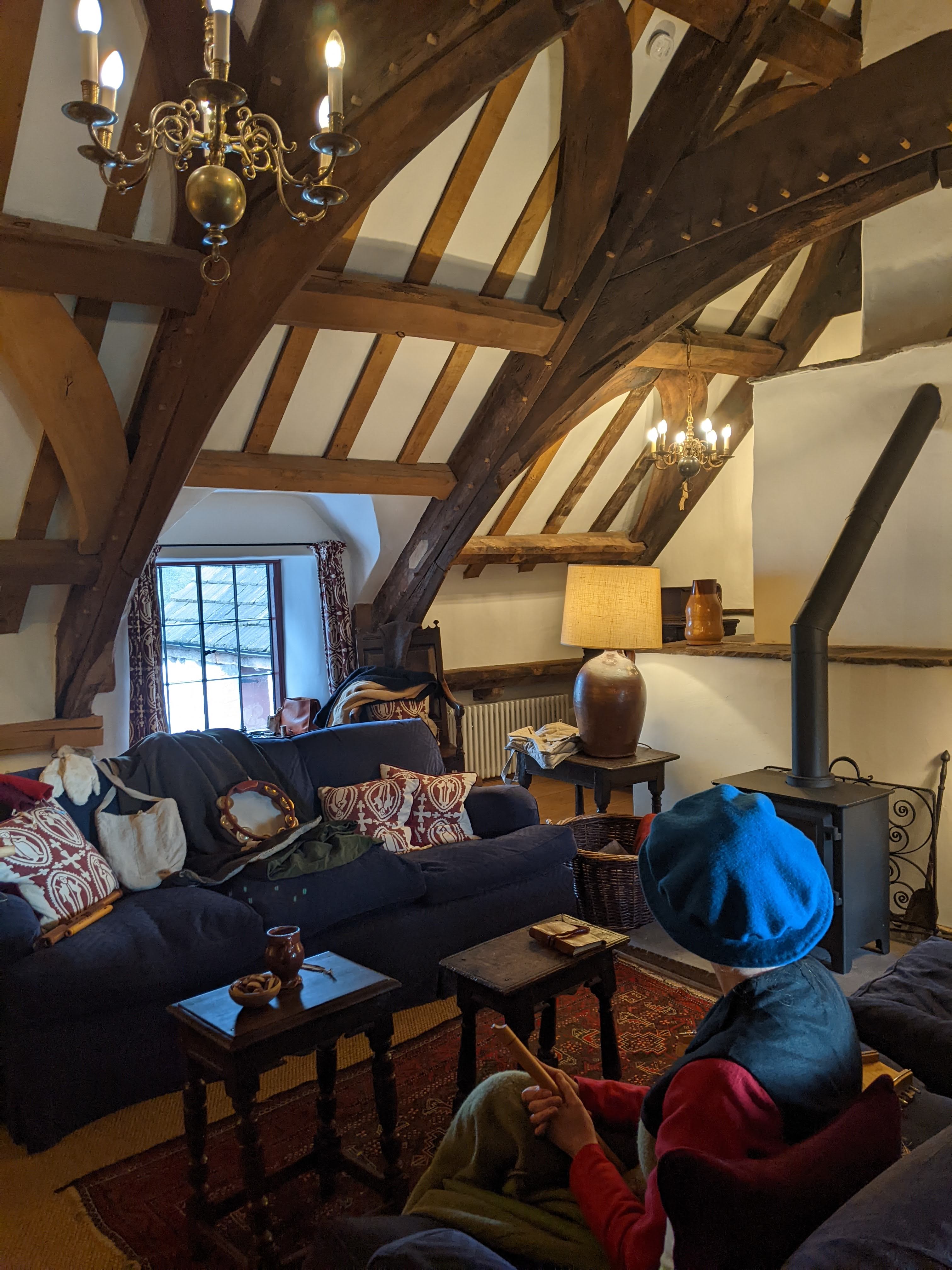
Interestingly enough, the best rooms are the bottom and top halves of the great hall. The bottom-hall is a dining space with a huge open fireplace. The fire was lit on the open day and created a special atmosphere. The upper-hall is, in my opinion, the nicest space of all. Because you are "in the roof", the magnificent timberwork is there for you to enjoy at close quarters and the lower ceiling means that the volume is cosier and easier to heat than it would have been in 1420. There is no doubt this is a fantastic space to chill with friends in front of the woodburning stove. In short, Llwyn Celyn, is very livable. Who would not want this place as their home?
lower hall
upper hall
On the drive to Llwyn Celyn, I spotted Raglan Castle at the side of the road. Oddly enough, I had just been researching Raglan Castle with no notion of its actual location. Perhaps, another trip to Wales is called for? :-)
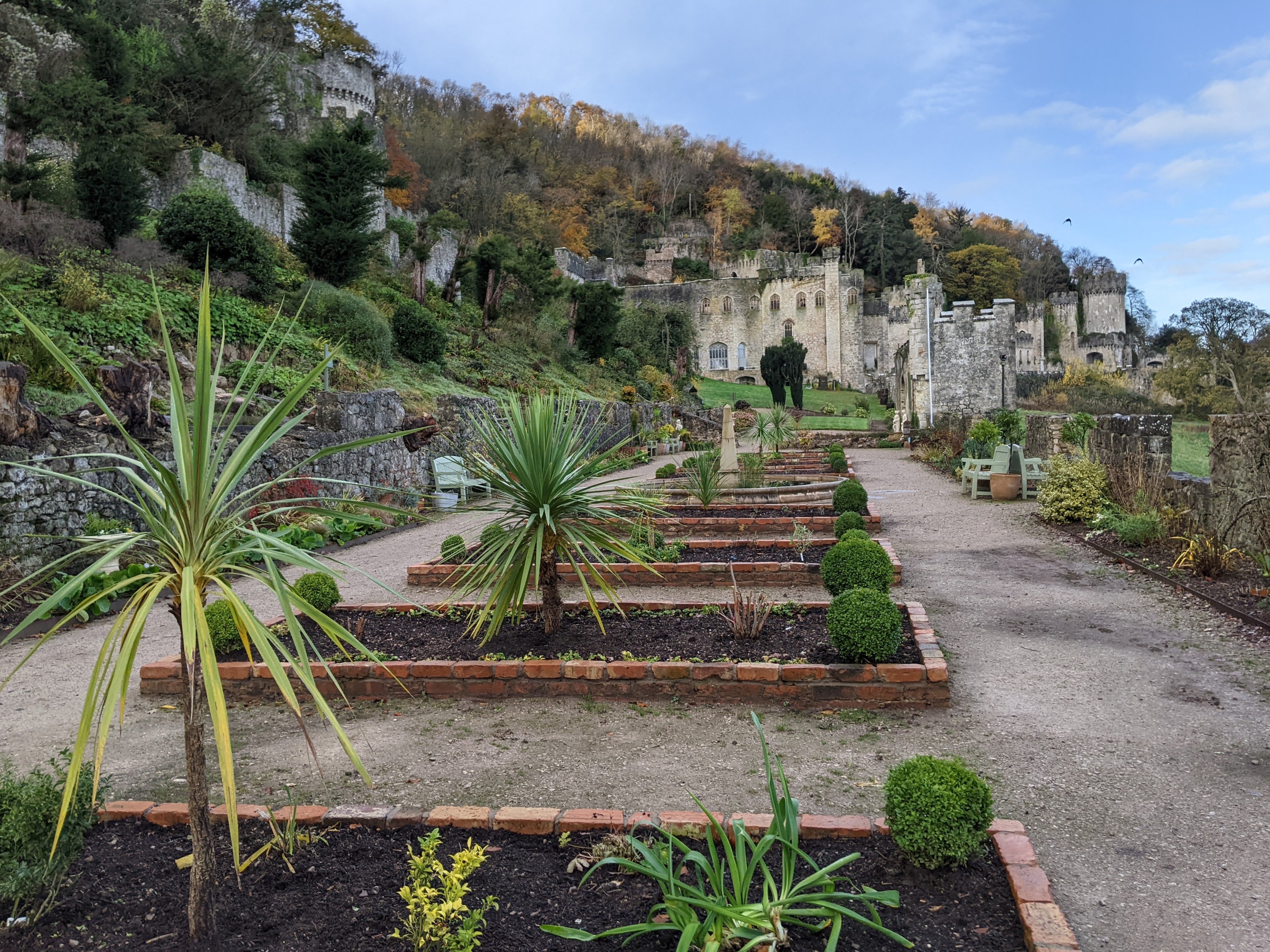
In 1999, when I was looking for a building to restore, one candidate that emerged alongside Balintore was Gwrych Castle in Abergele, North Wales.
In terms of the restoration required, Gwrych was an even more insane proposition. It is vast and almost totally derelict. On the other hand, it looks utterly magnificent. The way the blocks of the building are composed on the side of a hill is masterful, and they give an impression of a complete mediaeval citadel. The architectural term for the composition of building forms, skillful or otherwise, is "massing".
I investigated the status of the building online. It was owned by an absentee American businessman and there was a complex legal situation. "This will take 15 years to resolve." I guessed, and indeed that is more or less exactly how long it took! :-) But we are jumping ahead of ourselves.
I discovered there was a charity "The Gwrych Castle Preservation Trust" which had been started by a resident of Abergele called Mark Baker, when he was 12! I started chatting to Mark by email (who was 15 at the time) for the situation on the ground. I have to say that things looked hopeless for the Trust, there was little they could do without ownership. So we wished each other well with our respective "distant prospect" projects. The legal side of Balintore took the next 8 years to sort out, and I finally bought it in 2007.
In 2018, Gwrych was finally bought by the Trust and I sent a message of congratulations to Mark as I knew what a major and long-awaited turning point this was.
In recent years Mark has visited Balintore a number of times, and I finally got the invite to visit Gwrych today for the first time. So it was very much closing-the-circle. Would Gwrych in-the-flesh get me as excited, as the prospect of restoring her did 20 years ago?
The answer is a resounding "YES"! :-) Despite the insanity, I would definitely have taken on the restoration of Gwrych if the red tape hadn't been there.
The only true way to get a feel for a building is to visit it, and I hadn't quite got my head around the nature of Gwrych. Gwrych and Abergele are inextricably intertwined: a number of massive gate lodges are dotted about the town. These cannot be ignored. The castle looms above the town, so every resident of Abergele in invested in the building. The grounds (236 acres) act as a vast park for the inhabitants.
When I visited, it became clear the restoration of Gwrych is a dynamic community effort. There were around 30 volunteers in action: working on the gardens, working in the shop and building a number of Santas' grottos for the December season. As far as I can recall, Mark mentioned 3 full-time staff and 50 volunteers, benefitting from the fact Abergele is a retirement town. While most of the building is still in ruin, some areas have been restored and the gardens are zooming ahead. The dining room, now with a ceiling, is an astonishing space.
Most importantly, Gwrych is a going concern: an impressive sum was raised by their recent Halloween events. The money from the reality show "I'm a Celebrity, Get Me Out of Here" when Gwrych stood-in for an Australian Jungle during Covid, has been of huge benefit. I have to say I was totally fooled by areas of "film set" stonework built for the program. Mark invited me to tap some of the walls: these were foam with a very convincing coating that had been carefully colour-matched to the walls of the castle.
Balintore needs to learn from the community and team aspects of Gwrych. I talked to a number of the volunteers and they were universally lovely. They have taken much of the load off Mark, and he says this has been the best thing ever.
Mark had to attend a meeting on the Christmas ticket arrangements, which gave me a chance to really explore the building and grounds on my own and to pick up the vibes. Gwrych is not just a building, it is a 19th Century park that hosted tourists in the 19th and 20th Century. It could do so again in the 21st and indeed the grounds (paid entry!) are currently well used.
As you explore, there are certain areas where the massing of buildings and walls around you is entirely convincing: you could have stepped back in time to the middle ages. Massing is just as much about enclosed spaces as how buildings look on the horizon.
So Gwrych was a film set before there were film sets and Gwrych was a mediaeval fantasyland before there were theme parks. It is no accident Gwrych has been used for filming. Gwrych is the happy marriage between landscape, buildings and gardens. The castle is built on bedrock that is jutting out of the hill side, and seems to grow out of the ground.
What appears from ground level to be battlements, are in fact terraced formal gardens and scenic walkways. In fact, it was only by studying some aerial photos recently, that I realised that around half the castle is actually fake and these are gardens masquerading as castle. While Gwrych Castle is large; things have been carefully orchestrated to make it appears even more monumental and impressive from ground level.
Now Gwrych is a good news story. The road ahead will not be an easy one, but at least there is a road and individuals that are prepared to walk on it. I had the ruined parts of the building to myself for a while, and there was still the unadulterated thrill of a vast abandoned building and yet there was comfort in rather than the normal despair for such a building's future.
loved this Neptune statue
P.S. My camera phone died within minutes of arriving at Gwrych - typical! Well, at least the two bad photos I took are mine. :-) Search online to see the full magnificence of the building.