Friday, 28 August 2020

Women Servants' Bed Room

The women servants' bedroom on the top floor of Balintore Castle is the room currently undergoing restoration. This would have had, say, four single beds: housing kitchen and household maids very much in the fashion of a dormitory.  There are the remains of bell mechanisms in one corner, which would have been used to summon the young ladies to their duties. There are smaller adjoining rooms which I reckon would have been used as single bedrooms by the older or more senior female staff.

I thought it would be interesting for blog readers to see a pair of snapshots of work in progress. The first photo was taken on the 11th August, and the second photo was taken on the 28th August, which is today.

You can see the plaster-work repair round the dormer window on the left side of the images had been completed. This was done using a combination of plasterboard and also by pressing browning (undercoat plaster) into surviving lath. Greg often gives his plaster-work a coat of white paint to check on the finish, as you can see here.

New floor-boarding was completed over the whole room today. In the earlier photo you can see a small amount of existing flooring as well as OSB (Oriented Strand Board) sheeting which was used as a temporary floor covering so we could move about the room. The original plank flooring was affected by dry rot, but we are going to recycle the good lengths of this to floor smaller rooms.

While the trend is mainly forwards, a section of original plaster-work by the door on the right which looked sound has been stripped away. We discovered dry-rot behind it - water has obviously been running down this section of wall, possibly for decades. Apart from this, plaster-work repairs to walls and the ceiling are essentially complete.

It was very odd today to be able to walk around the entirety of this room. Previously, there were numerous large holes in the floor which one simply did not approach, as one would have dropped a long way down: all the way to the floor of the Great Hall beneath.

I have some reclaimed vintage oak units which we will re-purpose to fit out this gratifyingly large room. I can't wait! The transition of ruined space, that one passes through nervously and quickly, to usable accommodation is what it's all about.

To donate to the Balintore restoration project click here.

Women Servants' Bed Room 11th August 2020


Women Servants' Bed Room 28th August 2020

Wednesday, 12 August 2020

Fornethy House

Fornethy House frontage


It is rare nowadays that I get the chance to explore old, interesting and abandoned buildings, but when friend of Balintore Duncan invited me to view just such a building only 7 miles away from the castle, how could I refuse? As incredible as it may seem, I was totally unaware of the existence of Fornethy House, yet it is an intriguing architectural conundrum built as a summer residence for the Coats' family in 1915. Between the 1950's and 1993, it was used as a residential girls' school. You can see how close Fornethy is to Balintore from the map below:

At the entrance to Fornethy, where the drive turns off the road, there is a wonderful square-on view of Balintore Castle on the horizon. Anyhow, the most astonishing thing about Fortnethy is that it is built in 16th century Scottish style over-laid with a veneer of 1915 Arts and Crafts. Academically it is a very clever building and will appeal to architecture nuts like myself. Aesthetically, it is rather blocky and far from conventionally beautiful, but the balance and refinement of the detailing is superb.

It is too severe for a country house, and one wonders how comfortable the Coats felt staying here. Often such buildings can be relieved by rich interiors or landscaped settings, but Fornethy is currently surrounded by woods with no outlook and googling for images suggests the interior was rather plain. 

Although I like Fornethy, I would hesitate to say it is a success as a building though I refuse to make a final judgement until the ground surrounding it is cleared, and one is able to view it in a landscape. Much of the surrounding forest is for timber production, and presumably it would originally have sat more comfortably in its surroundings.

On returning to my car, I saw for the first time in my life what I thought where Chanterelles growing on the side of the Fornethy drive. I have been looking for these for decades! Thanks to the Seek app for confirming the identification, and thanks to Duncan for saying that my Chanterelle dish that evening was delish! It is a subtle flavour in my humble opinion but a good one, and the golden orange colour, enhanced by frying, makes for a beautiful presentation.

To donate to the Balintore restoration project click here.


abandoned greenhouse with vine

active bee hives

abandoned greenhouse

abandoned cars

carriage door on side of Fornethy

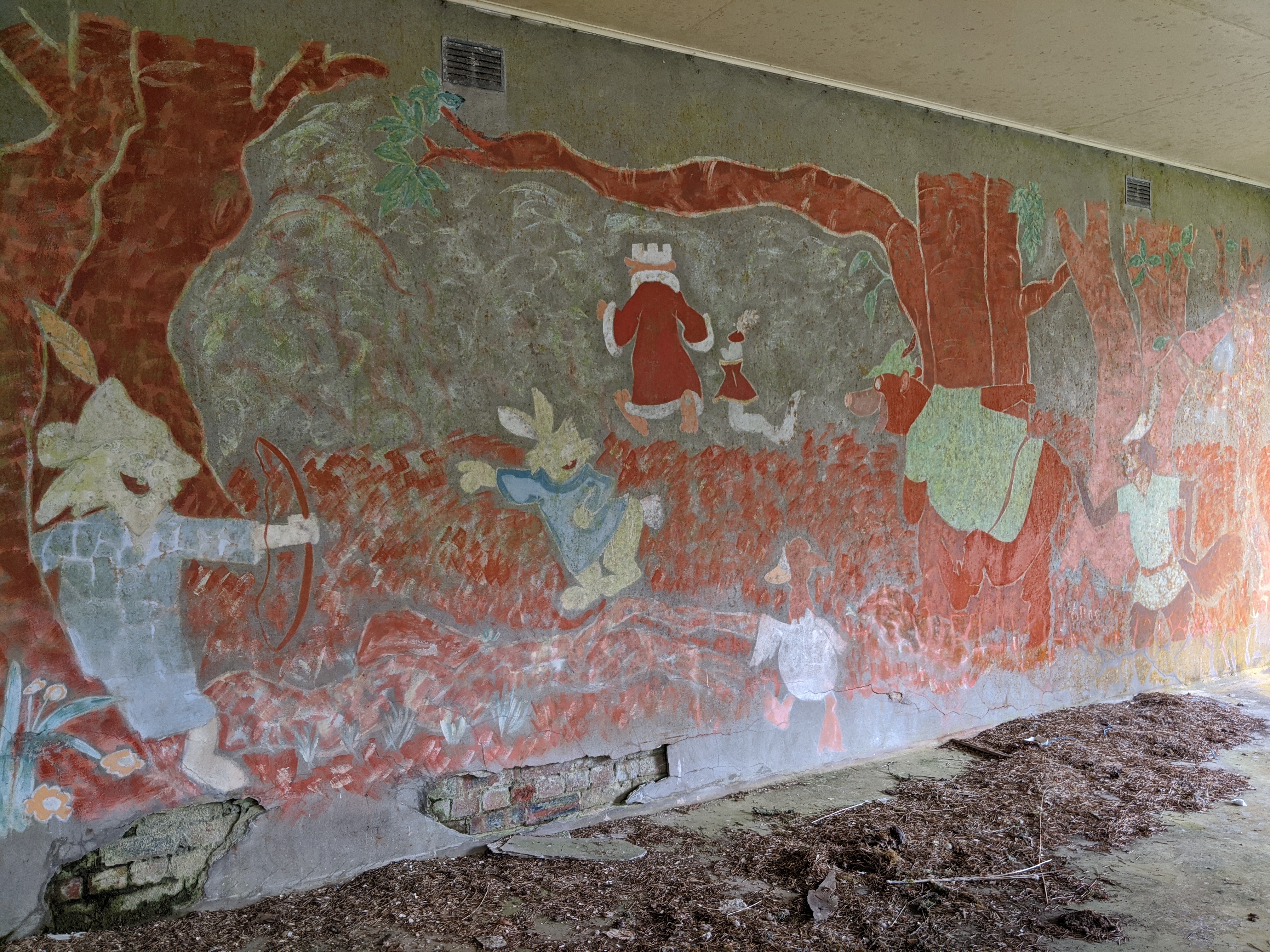
mural of Disney's animated "Robin Hood" (1973)

door on rear

rear of Fornethy

elevated rear entrance (stair now missing)

feature on left is later (lift?)

feature on right is later (lift?)

front entrance with lantern

frontage


Golden Chanterelles on Fornethy drive


Golden Chanterelles back in the Balintore kitchen


Dog Vomit Slime Mold

Recently I guided a photographer friend through the woods at the back of Balintore Castle. He wants to take some wedding photos at the castle, and there is a very good angle looking down at the castle from these woods. The magic viewpoint occurs in a particular clearing, but of course all I could find were nearby clearings where the view was just OK. After dragging my friend in a wedding dress unfriendly manner through the woods, we decided just to leave it there. ;-)

When some later visitors expressed an interest in a walk, I decided a second reconnaissance to find the magic viewpoint would be my way of not admitting defeat. What's more: the first reccie had revealed some interesting fungi. Perhaps something edible could be found?

Many thanks to friend of Balintore and vlogger extraordinaire Brian for finding a bright yellow marvel of natural history deep in these woods. This revels in the name of the Dog Vomit Slime Mold. It was once thought that slime molds were fungi, but these are now regarded as something else. Generally, slime molds live as individual cells, but they can come together and move as a colonial animal.

Dog Vomit Slime Mold at Balintore

Eventually, we did find the correct clearing. Pictured are my friends Allan and Jacki decorating the view. Jacki was returning a Victorian armchair which she had kindly repaired for me for free. A young visitor to Balintore had started bouncing on it, and had gone all the way through. I was really upset as it had taken me over 6 years to find an Victorian suite with original upholstery. Jacki re-webbed and re-upholstered the seat so it is even better than it was before, with a much more comfortable and sprung, rather than saggy, sit. 

magic view of castle from the woods


None of the fungi proper we found on the second reccie turned out to be edible, but watch this space for a more successful fungi update!

To donate to the Balintore restoration project click here.

Thanks to the Seek app for identifying the mold.


Friday, 7 August 2020

Crowdfund the Great Hall Restoration

Recently, I was pestered beyond human endurance by some delightful Spanish visitors to the castle to start a GoFundMe page. Actually, they used charm and irrefutable logic. And the bribe of a home-made tortilla, which turned out to be spectacularly delicious.

I thought it was time to go for the castle's Great Hall right in the core of the building. To my mind, the castle is not truly alive until its heart has been re-animated. I have appended the content of my GoFundMe page for posterity below, but you can follow the link directly to the actual page here.

Deterioration of Great Hall from 1968 to 2007, and the consolidated Great Hall today


I am raising money to restore Balintore Castle's Great Hall. I bought this A-listed property in Angus, Scotland 13 years ago from the local Council, on condition that I save the building. This has now been achieved: the roof has been fixed, new floors and new windows have been installed.

However, at the very heart of the building lies the cavernous, magnificent and sadly ruinous Great Hall, which is too costly for me to restore as an individual.

I would love to be able to restore this room in my lifetime and friends have repeatedly pestered me to obtain external funding. Now that I have consolidated the exterior of the castle, at great personal cost,  the time is indeed right.

The Great Hall is a triple height space which could be used as a music venue, a theatre, a cinema, or as an events space, hosting exhibitions, and workshops. In short, not only does it represent internationally important architectural heritage, but it could be a great community resource.

A externally contracted restoration of the Great Hall could easily cost £1m. However, I reckon I can bring it in at £100k, using the money-saving principles I have learned from restoring the other areas of this castle i.e. employing good local craftsmen directly, using reclaimed materials and auctions to obtain fixtures and fittings. I appreciate £100k is a big ask but for an individual to take on such a large project was also a big ask. :-)

A particular challenge will be the plasterwork ceiling, of which around 50% survives. The plan is to use the opportunity to train apprentices and local tradesmen in the traditional skills, to ensure their continuation.

I hope you will donate to this great endeavour. Anyone who donates will be very welcome to visit: to see how far we have come; the work in progress; and how far we have to go.

The Great Hall in 2007. This was open to the elements - note snow on the ground!


The Great Hall in 2020 - taken from ground level

The Great Hall in 2020 - looking down from principal bedroom floor.
Windows blocked up and roof propped


The story so far can be read here .

Dr. David John Johnston 13th July 2020

Sunday, 19 July 2020

Dymchurch No More

I recently acquired, courtesy of eBay, some 1930's some postcards of Dymchurch, a seaside resort in Kent. These are the without doubt the dullest postcards on the planet, and one fears that Dymchurch itself is squarely to blame. 


Dymchurch dullness (click to expose the dullness)

On the principle that the cheapest picture frames can be obtained by buying the worst art, it was the three glazed frames holding the twelve postcards of Dymchurch, that were my real objective. I was wanting to frame some wonderful Scottish landscape postcards that had been generously gifted to me by friend of Balintore Mrs. M. .

reverse of a gifted postcard


The postcards themselves are paintings in the romantic tradition produced by a French chocolate factory (Choclaterie d'Aiguebelle). To promote sales, the factory produced many different series of beautifully illustrated postcards on a variety of themes, generally educational. The firm was founded in 1868 by Trappist monks from the Notre-Dame d'Aiguebelle Abbey, and production went on into the early 20th Century.

My visiting friend Madeleine used her artistic skill to perform a life-saving postcard transplant, with the old postcards left in the back of the frames for historic purposes, and the new postcards inserted. The irony is that the new postcards are probably older than the old postcards.


Dymchurch no more (click to reveal the art)


I figured the plum cardboard mounts would work well with the blue/green tones of the paintings, and when Madeleine pointed this out to me without prompting, I felt vindicated in the eBay purchase. The plum washed out the monochromatic scenes of Dymchurch with the force of a tsunami on the placid Kent coast.

Anyhow, thank you Mrs. M.. There is a wonderful serendipity in the romantic caledonian vision of a French Trappist monk washing away the dullness of a Kentish coastal town. The walls of Balintore Castle are indeed gifted.


Thursday, 16 July 2020

Window Seats

It is good to be able to blog "live" in the sense of reporting progress on the very day of that progress.  All too often, I am writing articles about things that happened some time earlier.

Anyhow, today Gregor built window seats in two of the rooms inside the entrance tower. The rooms in the entrance tower are not large, so fitting seating in a window alcove is an efficient use of space. Window seats in these locations have been in my mind for many years, so it is good to see them finally realised.


new window seat in Ocean Room (blue paint colour on walls is "Deep Ocean")

You can see that the front of the seat is constructed from the same profiled planking that lines the window opening, which hopefully ties the design together. Gregor had cut the planking to size yesterday and painted it white. Today, he told me he did not have enough plywood left to form the seat. 


As these are permanent fittings in an A-listed building, I told him we should go for a solid wood seat instead and we chose a length of reclaimed wood which had come from an antique restorer in Manchester who was retiring. We thought the wood might be pine, but when Gregor burned off the thick layer of paint and then sanded it back it turned out to be mahogany - hurrah!

We didn't want the front of the seat to be level with the wall as we wanted to still keep the feel of an alcove, so we had to compromise on the size of the seat vs. the size of the remaining alcove. We chose a suitable depth of seat. then Gregor remembered we had some reclaimed seat cushions we could recycle. It turned out that the seat cushion was just a inch or so narrower than our compromise seat depth. It was a no brainer to make the seat depth exactly the size of the cushion.

The seat cushions come from Kirkhill Church in Glasgow. The pews and radiators were being stripped out so some cushions were going spare. Gregor likes the purple hessian material covering the cushions, but this is too 70's for me, and I have some nice damask to recover the cushions. However, when we cut the foam to the appropriate trapezium shape, I might just patch-up the hessian as a first pass solution. 


I would love to run up the cushion covers myself, but I have loaned my sewing machine (which was my Mum's) to a friend.


Ocean Room window seat with pew cushion, which will be cut to size

When Gregor showed me the first window seat I was delighted, but he had used steel hinges on the part of the seat that lifts. I asked Gregor if these could be brass instead, given the metal's heritage superiority. Gregor duly changed the hinges on the first seat and installed brass hinges on the second.

Gregor pointed out that neither the posh mahogany nor the posh brass hinges would be seen with the cushion in place! I tried my usual "But we are doing this castle up properly" line. I could tell he wasn't convinced. :-)


new window seat in Yellow Room (paint colour on walls is "Honey Bee")

And to finish, a quote from Napoleon which I first discovered on the London Underground:
 

"A throne is nothing but a bench covered in velvet".

It made a great impression on me, and made me re-evaluate the man. Perhaps he was more than just a dictator?

Sunday, 5 July 2020

Summer Nature Watch

One of the joys of Balintore's location is being able to observe the change in fauna and flora with the seasons. The foxgloves this year are not quite as spectacular as last year, but I always take delight in the "sports" which are not the standard purple. Below is a hasty arrangement of a white spike, a pink spike and a standard purple one.


tri-coloured foxglove display

This year I have been suffering from marauding sheep more than ever before. These are sheep that come from neighbouring fields and munch on Balintore's grass. Who can blame them? I don't do any lawn mowing myself, so their attentions are almost welcome except when they rip up my few plants.

Today, I had my first ever marauding cows: two calves who thought the grass was greener at Balintore and just went for it. Calves can clearly slip through fences much more easily than adult cows, and I would be very surprised indeed to see a full-sized cow at Balintore.

Greg and Gregor spotted a brood of wildcats in a hidey-hole within the castle grounds: a mother and three tiny kittens. At one stage, apparently, the mother was carrying one of the kittens. I was called over, and despite crawling on my hands and knees in the locale, did not spot them. Anyhow, we were all totally delighted. I am not a (domestic) cat lover, but a brood of wildcats in your garden is pretty special.

I was just about to do my food shopping, when I spotted some vegetation on top of one of my vehicle's tyres. My previous food shop has been over 3 weeks ago due to covid. "Typical," I thought, "trust me to pick up some grunge on my tyres.". I pulled out the vegetation, and to my surprise I found myself with a bird's nest in my clutches with a very annoyed blackbird sitting in it. She looked at me, emitted a loud cheep, and flew off. Underneath was a clutch of 4 beautiful blue eggs:


4 blackbird eggs in a nest

I was bowled over by the perfection of the round form of the nest. This was the first time in my life I had held an occupied one. At Balintore, nature comes to you.