Monday, 19 August 2024

The Infinity Box

Last Saturday lunchtime, I dined with a delightful lady whose right-side was painted white and whose left-side was painted black. I urged her to not spill the beetroot soup, for its resemblance to blood, be-spattered over her gothic-inspired black and white costume would take her already terrifying appearance over the level that would cause me to flee.

I had assumed, rightly or wrongly, that this was not a stray spirit loosed in the castle basement, but an actor taking part in the filming of "The Infinity Box" at Balintore Castle over the weekend.

Joel, the director of the project had made contact with me through a mutual friend called Karen. When I dealt with Karen she was an antique dealer; when Joel dealt with Karen she was a Bollywood location scout in Scotland. All this goes to illustrate that each of us can do many things in life. One of my personal bêtes noir, is that a CV has to show a career path struck in a single discipline rut.

Anyhow, the film cast and crew were lovely and though one might feel one is not part of that world, you have to realise that not all members of the team will have worked together before, so they are open to meeting new people including oneself. And indeed, we all share a deep love of film.

The scenario of the 15 minute film, which forms just part of a multi-media art project, makes little sense to me, but here goes. A Scottish maker was commissioned to create a hand-written book. Another Scottish maker was tasked with creating a hand-woven fabric bag in which the book is placed. Another Scottish maker was tasked with creating a box, in which the bag and ultimately the film/DVD will be placed.

The filmed sequence features two creatures: one inside the mirror in a parallel universe and one in front of the mirror in the real world: very much in the tradition of "Alice through the Looking Glass" and Jean Cocteau. I know no more, but will be fascinated to view the resulting film sequence which was shot entirely in the "Gentleman's Dressing Room" at the castle.


the shoot

It was interesting to observe how much of the production effort took place in the corridor outside the "studio" as the crew studied monitors, etc

technicians in the corridor

Here are some images from the black and white production.

the result

Book your tickets now!

Cineastes amongst us will not fail to note the commonality with the similarly named British technicolour film "The Magic Box" (1951) and the Star Trek episode "Let That Be Your Last Battlefield" (1969).


still from "Let That Be Your Last Battlefield


Saturday, 17 August 2024

Gregor's Secret Door

As I passed Gregor in the carpentry workshop at the end of a working day recently, I asked "What have you been up to today?". "You can see for yourself.", replied Gregor.

So I walked into the Great Hall which is where we are currently working. I failed to observe any visible change, and was too embarrassed to pursue the matter further, so I slipped past Gregor discreetly and exited the scene hastily.

The next morning, as I walked into the Great Hall, the difference was staring me in the face: where there has once been a blank opening with a stone wall behind it, was now a Gregor home-brew Victorian door.


Gregor's Door


It's a pretty decent recreation of the surviving Victorian doors, all done without the intervention of a specialist carpentry workshop.

Here is a surviving Victorian door for comparison. This is still covered in the detritus of the building's ruination, which we haven't even attempted to clean off.


Original Victorian Door.

The only different is the paint job! The Victorian door has a paint effect using light and dark brown paints to emulate oak. Gregor's door is just painted in the light brown colour (Mexican Tan). If anyone knows how to apply the paint effect using the dark brown paint on top, then please get in touch! I know that the technique is called graining or scumbling.


Thursday, 1 August 2024

Gorky's Sun Dog

On the 12th of July this year, I organised a dinner party at the castle for my great friend Görkem (Gorky). Gorky was last in Scotland 10 years previously, so it was very much an occasion for celebration. I sneaked-in some surprise guests who Gorky had not seen, since we last worked together for a computer games company in Dundee.

Just before the meal, Gorky announced there was something interesting going on in the sky which he had seen from his bedroom at the castle. We all rushed out, and the amazing phenomenon lasted another 5 minutes or so before fading away.

We all savoured that special moment of being together as mother nature did her showiest best. I am presuming this is a sun-dog, but if anyone else knows to the contrary please let me know. I had seen sun dogs before, but this was against an otherwise dark sky which spectacularly highlighted the rainbow colours.


telephoto shot from Gorky's bedroom window


standard shot from Gorky's bedroom window


Tuesday, 25 June 2024

Botanical Notes III

Further adventures in trying to master wild flower identification. I often see this small purple flower growing at ground level, but have never given it much thought. Down on my hands and knees this evening with the 7x digital zoom on my mobile, the flowerhead is a complete revelation: looking almost like an exotic orchid. The Seek App tells me this is the Common Self-Heal. It is edible and used in Chinese medicine. Never-the-less, I doubt it could provide a substantial meal - look at the Clover leaf in the background for scale! :-)

Common Self-Heal (Prunella vulgaris)


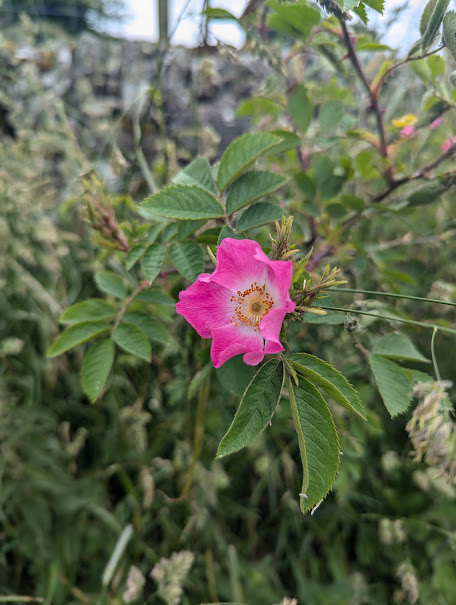
Even I can identify this deep pink beauty as the Dog or Wild Rose. Amazingly Seek could not get any further than the rose "family". A tiny victory for me. :-)


Dog Rose (Rosa canina)

On my botanical peregrinations, I could not resist the following vista of the Daisy and Buttercup meadow below the castle. This evening was not sunny like yesterday, with the low cloud smudging the tops of the nearby hills, but it was pleasantly warm in a T-shirt even with the touch of mist on the skin.

Meadow Buttercups (Ranunculus acris)  and Daisies (Bellis perennis)


High Summer Mowing!

It's High Summer at Balintore Castle!

This year we have neither had the usual biblical plague of rabbits, nor the annual invasion of sheep. I usually rely on said fauna and livestock to tend my lawns for free. So this year, I asked my friend Andrew if he could give the terrace a once-over with a flatbed mower.

Yesterday, as I looked out of the high castle windows at the work in progress, I realised what a glorious summer day it was and how lucky Andrew was to be outside. I was doing simultaneously stressful and dreary admin at my desk.

The field below the castle is awash with buttercups, thanks to the organic farming practices of the local estate. If you zoom into the images, you will see how beautifully intense the yellow is.

high summer mowing - looking west

high summer mowing - looking east

Saturday, 15 June 2024

Botanical Notes I

I am a great lover of nature but do not know enough species names. The philosophical question is whether there are always more names to learn so one feels perpetually inadequate, or whether at some stage a degree of mastery can be achieved? I suspect the latter will forever be out of my reach.

Anyhow at this time of year, the wild flowers are out and surely this sub-category of nature must be more tractable? Joyous colours and forms must also surely make identification easier as well as pleasurable?

This afternoon's walk up the Dairy burn in the rain and thunder was at least a start.

I spotted both pink and blue Forget-Me-Not flowers on the same stem! All the other Forget-Me-Nots on my walk, were the standard blue.


Forget-Me-Not (Myosotis scorpioides)

These pink orchids are very different from the purple Marsh Orchids growing in the castle's formal garden:


Common Spotted-orchid (Dactylorhiza fuchsia)


I would call this Scotland's Baby's Breath, but I was finally able to identify the plant as the Marsh Bedstraw:


Common Marsh Bedstraw (Galium palustre)


I was looking at "small buttercups" this afternoon, and speculated that they perhaps were not Buttercups after all. The Seek App told me there were Tormentil.


Tormentil (Potentilla erecta)

And of course, Tormentil have 4 petals and Buttercups have 5. Duh! How had I never noticed this before? I thought I had seen the name Tormentil before in connection with Scotland but I couldn't place it. Was it the name of a ski run or was it the name of a whisky? Anyhow, some frantic googling revealed that there is a Tomintoul (different spelling) whisky and a town of the same name in the Cairngorms.

It goes without saying that you should alert me to any plant mis-identifications in the above!


Thursday, 13 June 2024

Messieur Asquith Requests

Two historically significant letters were found in the castle in the 1960's in the hallway just to the north of the Great Hall. To save the items from a building that was disintegrating, the letters were removed. On the first of June this year, the letters were returned to the castle after a rather lengthy detour in the US.

I am so grateful that the letters were kept safe for so long, and I am pleased to be able to share them on my blog.

The first letter was written on the 30th March 1915 by the Prime Minister of the day, Herbert Henry Asquith, to the 1st Baron Lyell of Kinnordy asking him to become the Lord High Commissioner to the Church of Scotland.


I have transcribed for your reading pleasure:

Confidential.

                   10,  Downing Street,
                     Whitehall. S.W.
                 30th March,1915.

Sir,

    I have the honour of proposing,
with His Majesty's approval, that you
should be appointed Lord High Commission-
er to the Church of Scotland.

           I am 
                 Yours faithfully
                H.H.Asquith

The Lord Lyell.


The second letter is Lyell's reply, which is an emphatic but polite "no". He cites his wife's illness as the reason, but reading between the lines he didn't want to be bothered. As a Liberal member of parliament, he was raised to the peerage in 1914 and how many more roles can a chap take on?


Again, I have transcribed for your convenience, but the handwriting is surprisingly legible. What is graphologically interesting is that Leonard uses a ligature to connect the last three words "propose for me". This suggests that he finished the letter very quickly, and was impatient to be done with the matter.


            48,EATON PLACE,
                        S.W.


Dear Mr Asquith,

      I am much honoured 
by your proposal that I
should be High Commissioner
to the Church of Scotland ;
and much regret that I
find it will be quite
impossible for me to
fill the position satisfactorily

   Lady Lyell is unfortunately
very ill and has been so
for the last three months
There is very little
probability of her being
fit to take part in any
social functions this
summer.

    In these circumstances 
I hope you will understand
that I cannot accept the
honour that you so kindly
propose for me.


There are some grounds for confusion whether the correspondent is Leonard Lyell (1st Baron Lyell) or his son Charles Henry Lyell, especially as Charles Lyell was Asquith's private secretary between 1908 and 1915. The letter is simply addressed to Rt Hon. Lord Lyell. Both Leonard and Charles were members of parliament so both were "honourable". You need to be a member of the privy council to be "right honourable" but my research on membership of this august body fails me here. However, Charles never inherited the Baron title as he predeceased his father (1918 c.f. 1926), and Barons are addressed as Lord.

So to summarise, Asquith was offering the Commissionership to the father of his private secretary in the best British tradition of nepotism.

Herbert Henry Asquith


Leonard Lyell

I rather like the look of Leonard, he looks a sensitive but responsible and thorough type. I have not done a great deal of research, but he was careful to archive his uncle's correspondence. Leonard Lyell's uncle was Sir Charles Lyell, the founder of modern geology and an early supporter and friend of Charles Darwin.

It is a shoe-in that Charles Henry Lyell (born 18th May 1875) was named after his great-uncle Sir Charles Lyell (died 22nd February 1875), as there is just three months between the death of the latter and birth of the former.

Leonard's son Charles Henry Lyell died of Spanish flu working in the US as a military attaché, just before the end of WWI. Asquith was forced to resign in 1916 presumably as a result of the disaster of WWI.

I already know H. H. Asquith very well, as he is buried in the churchyard in the small Thames-side village of Sutton Courtenay where I own a house. It's a small world! Asquith lived in "The Wharf" where the emergency cabinet meeting that declared war took place. I never tire of stating that WWI started in my village. :-)

Here is an image of Leonard Lyell's Belgravia address where the letter arrived: 48 Eaton Place. This is valued at £3.5 million.

48 Eaton Place, Belgravia


Fans of the old TV series "Upstairs Downstairs", a hugely successful precursor of "Downton Abbey", may recognise the address. The drama was set at 165 Eaton Place, but actually filmed at 65 Eaton Place - with a painted on "1" to give the owner some anonymity. Featuring in a drama, is a sure sign that the street was and is extremely des-res.

It is unclear whether No. 48 extends to the right of the front door or to the left. However, as No. 44 and No. 46 are mirror images of each other, then No. 48, by a process of deduction, extends to the left.

H. H. Asquith's son was Anthony Asquith, the famous film director. Asquith's great grand-daughter is Helena Bonham Carter, who bought back one of the family homes in the village.

And coincidentally, a letter from Charles Darwin was found tucked into the bottom left hand corner of a painting by Landseer on the north wall of the Great Hall at Balintore Castle. What I wouldn't give to get hold of this letter. The Landseer would be quite nice too. :-)