Tuesday, 22 June 2021

Servants' Hall Progess

The Servants' Hall in the basement of Balintore Castle is my second favourite room after the Great Hall. The Great Hall is such an expensive restoration challenge, that I have started a GoFundMe page to help raise the required funds.   However, the Servants' Hall is a more practical proposition, although we only started working on this space relatively recently.

This blog entry is a significant checkpoint for the Servants' Hall restoration work, as we have now finished plastering the walls and finished plastering the ceiling. All the plaster had fallen off the ceiling due to water ingress, and most of the plaster has fallen off the walls. Any remaining plaster was on lathe-and-plaster which had been destroyed by dry rot. The bottom half of the walls (concrete render rather than lathe-and-plaster) had mostly survived, so we patched new materials into this. Permission had been obtained from Angus Council to use plasterboard on the upper half of the walls.

Greg gives surfaces he has newly plastered a coat of white paint to check the quality of the finish. After this, there may be some subsequent filling. Plastering the curved ceiling for days at a time was a particular challenge, and Greg put his neck out. However, he was very stoic about this and I only found out from his father Gregor much, much later.

The transformation had been a delight to view - with the space moving from the distinctly derelict to something one could imagine living in, courtesy of the smoother wall and ceiling surfaces.

You can see we have left a beautiful stone arch exposed. When fabric is lost, there is an opportunity to do something a little different, and I couldn't bring myself to hide this arch under plaster even though this was the original decorative schema.

servants' hall looking north

Another reason for taking these photos was to record the original colour of the room before we paint it again. The colour was a cream which can be seen on the bottom half of the walls. Obviously, much of this has become discoloured and stained over time. 

servants' hall looking south


servants' hall looking east


My favourite area of this favourite cruciform room is the cross-vaulting in the ceiling where two arches meet at 90 degrees. You can see the hooks for a chandelier here. The chandelier is currently being cleaned. We are still working on this room and it is getting more and more presentable on a daily basis. I am hoping to get a fire going in the fireplace to heat up the room. Even on a warm summer's day like today, it is always slightly chilly as it is partially below ground. Only very, very occasionally on a boiling hot day, is this chill actually welcome. :-)

Monday, 21 June 2021

Courtyard Troughs

Friend of Balintore, Karel, is a keen and knowledgeable gardener. As I am neither, it was no hardship and indeed a huge relief to delegate the planting of the troughs in the castle courtyard to Karel in preparation for the castle's open day on the 10th July.

The hostas and lavender have survived from the previous year, but everything else is new. Karel was careful to install some more plants which would survive over the winter, whereas I would have just gone for cheap and cheerful colour without the superior longer term approach of an expert.

The enclosed castle courtyard is the one area which is not subject to the onslaught of rabid rabbits and sheep. All my plantings elsewhere have been munched - so the lesson has been learned.

Anyhow, I am very much looking forward to the troughs becoming a riot of seasonal colour.


Karel's blue trough planting

Karel's warm colour trough planting


Saturday, 19 June 2021

Chandelier Restoration

Friend of Balintore, Karel, has bravely stepped in to restore the chandeliers in the servants' hall. I probably brought the lights about 10 years ago and put them up in this basement room just to cheer myself up. It is only recently that we have started restoring the room around about the chandeliers.

Over the last 10 years in the damp and cold basement, the iron of the lights has rusted, and the recent plastering work has covered the glass shades in plaster.

Karel cleaned the plaster off the glass shades. In the image below the "before" shades are on the left and the "after" shades are on the right.


glass shades before and after restoration

Karel removed the rust from the chandelier framework and then repainted the whole thing black. He even built a dedicated chandelier restoration framework, on advice from Gregor.

Karel and his repainted chandelier

Sunday, 6 June 2021

Rothesay Rooms VIP Opening

When glamorous Gallic Caledophile Solveig asked me to be her "plus one" at the VIP opening of Prince Charles's restaurant "The Rothesay Rooms" in Ballater on the 19th of May this year I accepted immediately. I was a little embarrassed when subsequently I felt obliged to ask why she wasn't taking her boyfriend instead. Apparently, I have the superior palette. :-)

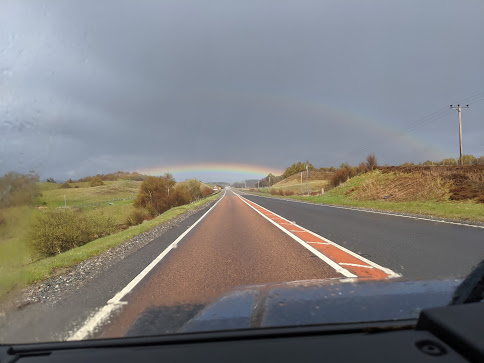
Solveig drove us from Dalwhinnie to Ballater. The first half of the route treated us to a rainbow on the road. The second half of the route was the A939 which passes though some astonishing scenery. It was the first time on this road for both Solveig and myself, and it is now our new favourite road!  The Lecht Ski Resort is on the A939 and it was still harbouring the odd snow field. The resort is even tinier than I had expected!.

the drive to Ballater


At one stage we turned a bend and found ourselves looking down on the brilliantly white Corgaff Castle, against a background of rugged Highland scenery. The sight took my breath away, and confirmed that even after many jaded years of restoring Balintore Castle, the spectacle of a magnificent building in a magnificent landscape still holds a special magic.

As I walked into the Rothesay Rooms I was handed a glass of champagne. Given that we were supposed to keep our masks on, I had no idea what to do with the champagne. Many other mask-wears, however, had clearly been carrying their full flutes for some time and were looking similarly distressed.  I engaged in some small talk with the be-fluted and be-masked. Naturally, no-one addressed the elephant in the room: "What to do with the champagne?". 

Finally, Solveig bravely asked what she should do with her non-alcoholic alternative, and a member of staff pointed her to a table in a dining room off to the side of the corridor where we were standing. The relief of being able to sit-down, de-mask and swig was palpable! 

An employee of the The Prince's Foundation, Robert Lovie, gave the invitees a good-natured speech explaining the background of the opening. Five years previously, Ballater had been hit by serious flooding. You may recall the news item about Abergeldie Castle which almost collapsed into the River Dee, as the torrents had eroded the bank of the river right up to the edge of the castle.  Almost unbelievably the historic building was saved, by massive emergency earthworks. In the same year, there was a serious fire at the Royal Train Station, where in the 19th Century Queen Victoria would disembark for her holidays at Balmoral.

Prince Charles realised that the economy of this little Highland village desperately needed help and started a pop-up restaurant called "The Rothesay Rooms" in the centre of the town in a small building leased by the Co-Op for a peppercorn rent. Such was the success of the pop-up that it became a permanent feature of the town. Last year the Co-op announced their intention to sell the building, so a new home was required for the restaurant PDQ. The obvious candidate was the restored railway station which already houses a café.  So a room inside the station was refurbished in best Baronial style, and it was the opening of this space that the event was celebrating.

No expense had been spared on the décor. The wooden panelling was painted a delicious green. Pictures of stags abounded, and the seats and some walls were upholstered in the beautiful Rothesay tartan. I admired the pleasing result a little enviously, as the budget was a different order of magnitude from mine at Balintore.  Part of my reason for attending was to show my support for the restoration and reuse of old Victorian buildings - demonstrably a cause close to my heart.

Solveig in the new restaurant

The old waiting room had been restored as a magnificent formal dining room with a single large table. Although, it looks authentically Victorian, sadly nothing is original due to the fire. The woodwork was new and the very best of class. Mr. Lovie explained that the replacement  antiques has been bought from the Georgian Antique Centre in Edinburgh. Edinburgh dealers charge full whack. I know this from friends who live in Edinburgh, so I cannot begin to imagine what the period re-furnishing of the station cost.


the old waiting room


the old waiting room


the old waiting room


the old waiting room

Mr. Lovie revealed that he was the voice of the Braemar Games, which had just been cancelled a day or two earlier. My view is that this cancellation is a mistake, but of course caution is understandable where big commercial interests are involved.  Mr. Lovie is an avid collector and wearer of historic sporrans, with an ensemble of 43 dating back to the early 19th Century. Solveig is equally knowledgeable on the manufacturers of Scottish attire, and soon there was a conversation mentioning a number of contemporary sporran manufacturers, known both to Solveig and Robert. It was one of those conversations where I could contribute precisely nothing! :-)

The chef Ross served up canapes reflecting the menu in microcosm. These were delicious, and each type of canape was a taste sensation in itself. Because of the variety, Solveig and I almost felt we had had a complete meal, though it must be admitted that we both had an evening snack after we got back to Dalwhinnie!
 

The Canapes

The drive back to Dalwhinnie was just as spectacular and I recorded a little video of us going back over a humpy-back bridge that could give a roller-coaster a run for its money.


I reflected on the lessons learned in Ballater. I had met a number of lovely and dedicated people who work for the Prince's Foundation in Edinburgh.  The organisation had done wonders for Ballater: the Rothesay Rooms is fully booked up for the foreseeable future and the profits go to the Prince's Foundation.

The Foundation personnel mentioned the work being done at Dumfries House in Ayrshire, which supplies training in traditional building skills and training in the catering industries, and I began to strongly feel that Balintore could benefit from Charles's magic wand. Prince Charles stepped-in at the last minute and saved Dumfries House and its contents (some of which had famously already gone to the auction room but were fetched back) for the British public.

Solveig and I recognised no VIP's at the opening, and I pointed out with an impeccable logic, that by a process of elimination we must be they! This was confirmed by the fact that a number of guests did recognise Solveig from her web presence, which she found gratifying. Sadly, I gained no such reassurance. :-)


Ballater Royal Station: The Café

Ballater Royal Station: The  Victorian Revival Loo

Ballater Royal Station: The Entrance


Wednesday, 2 June 2021

Big Fella

 In life there are consequences ...

When one bids a stupidly low price on a stupidly large taxidermy stag head at an online auction, then one must prepared to transport the lot, however unlikely winning the item may seem.

Such was my lot in life, as "Big Fella" at Ryedale Auctioneers in Yorkshire unexpectedly came through.


Big Fella


I phoned Ryedale's to ask if I could leave the pick-up for a week so I could collect in person as I drove from Scotland to England. Thankfully they agreed, and I was able to avoid the hassle and expense of a courier. 

The drive yesterday to the auction house was across the North Yorkshire Moors National Park. This was my first visit and the scenery in the glorious sunshine lifted my mood.

The auctioneer kindly carried "Big Fella" to my pick-up, but was clearly unconvinced that the statuesque stag would fit into my back seat. However, I could visualise that a rotation while inserting would do the trick, and I handled the final spatially-informed thrust myself.

Apparently, a mature stag has 12 to 17 points on its antlers, but Big Fella is a mere 10-pointer and so would have had a little more growing to do. Here are the names for stags with certain numbers of points or tines which must be evenly distributed between left and right, for your handy reference.

number of points

name

12

royal

14

imperial

16

monarch


I am very much put in mind of the pivotal scene of the film "The Queen", in which the Queen, played by Helen Mirren, has a spiritual and almost magical encounter with an Imperial stag in the woods. This is the moment when she bends to the public will over the death of Diana by leaving Balmoral for London.

The screenwriter, Peter Morgan, once commented on his use of an Imperial stag:


It sort of dawned on me as a metaphor, really, when I learned that, you know, a stag that has 14-points is a stag that should generally already have been culled. It is something that has somehow escaped capture. It resonated for me. You know, I feel pretty much the same way about our monarchy. I feel that, for some reason, they've managed to get away with it. They've survived, perhaps longer than one might have expected.


Anyhow, Big Fella caused me to have my own magical encounter with the North Yorkshire Moors. His transport back to Balintore will be coals to Newcastle. :-)


Sunday, 23 May 2021

We're Going on a Deer Hunt

Some friends kindly invited me on a free mini-holiday: a few days in some holiday accommodation going spare in the wilds of the Highlands. In exchange, I offered to do the catering for the first evening. What could be more appropriate for the area than a venison casserole?

Anyhow, I approached the venison farm local to Balintore Castle on the principle that one should encourage local businesses. The owners are lovely and I have patronised them on previous occasions. "We have no diced venison" came the disappointing reply. However, they did usefully suggest an alternative venison farm just outside Forfar. This farm has a Web presence that allows you to make the purchase online, and this I duly did emailing to suggest a pick up time. From the response indicating venison would be coming in the following week for my order, it became obvious that they had nothing in stock at that moment and that I would have to cancel as my departure was in a couple of days.

Greg photographed these deer in Glen Quharity by the castle a couple of weeks ago.

When I expressed my despair to Greg, he suggested I ask the gamekeeper who lives next-door. Duh! Why hadn't I thought of this before? The gamekeeper came back to me very quickly, and he had indeed shot a number of deer a couple of days previously, but everything had now gone to the game dealers.

As the holiday was now looming, I would have to make an emergency trip to the butchers of Forfar. In fact, Forfar is very well provisioned  for butchers and has some excellent establishments. I would have  to be thorough and systematic. I found 5 butchers on Google Maps, and Gregor had already recommended to me the butcher (let's call it butcher "A") most likely to have venison.

I called in at butcher "A". They did not have any venison, but the man behind the counter was extremely polite in such an old-fashioned way, that I was taken back to my childhood in Scotland. Good butchers are a characteristic feature of Scottish towns and have a high standing in the community. This is markedly different from my experience in England. I am always ashamed taking French friends to Scottish cake shops. I love a fluorescent-red strawberry tart but it lacks the sophistication of their patisserie. However, I would stand proudly by any Gaul in a Scottish butcher.

Anyhow, I asked butcher "A": "Who would be most likely to have venison in Forfar?". I was given the name of butcher "B" and made my way there. Butcher "B" not only stuck the knife in: "We do not have any venison." but then gave it a little twist "And what's more deer is out of season!". Without thinking I blurted out "Well, I live next-door to a gamekeeper, and he killed some deer a couple of days ago". This seemed to make the butcher a little angry, and I tried to say something appeasing "Are you saying I shouldn't try any other butchers in Forfar?". "You can try if you want." came the sharpish reply.

I progressed to butcher "C" rather dejected expecting further failure. However, the man disappeared into the back shop, and came out with a huge bag of diced venison.  Success! I suspected I would need most of the bag. He weighed out 1.5 Kg, but then decided to throw in the remainder for free, which amounted to a very generous 2 Kg for the same price. This would never happen in Tesco! A quick conversation with butcher "C" about butcher "B", established the incorrectness of his remark. Deer, apparently, is in season for most of the year. 

I am sufficiently mischievous/didactic (you decide) that I was going to disavow butcher "B" of his misapprehension on the way back to my car. However, the staff member behind the counter had changed by the time I walked past again.

Talking of Tesco, next I popped into Forfar Tesco for celery for the venison casserole. Lidl has been out of celery when I had done my main shop. As an aside, I checked the red meat aisle - Tesco had had diced venison all along!!!

In fact, Greg has told me that this was likely to be the case, but I was rather dubious and it would have been my last resort rather than my first port of call.

Anyhow, the venison casserole I made in the end was so large that it supplied a number of meals, and I am still using it up.

This blog story brought to mind Coleridge's "water, water everywhere and not a drop to drink.".

I recall visiting Brodick Castle on Arran as a teenager and being overwhelmed by the number of taxidermy stags on the stairs. It took me a long time to find an image on the Internet that confirmed this memory. Perhaps this is the biggest assemblage in the world? 

Brodick Castle

And on a similar theme, is the collection of stag skulls and antlers at Mar Lodge in Aberdeenshire the largest in the world?


Mar Lodge


And as a final exercise for the reader, are the deer that Greg photographed young Red Deer or Roe Deer? The deer are rather far away, but don't look spindly enough for Roe and are herding like Red, but I cannot make out any large hinds or stags that would make them clearly Red.

Wednesday, 12 May 2021

Snooker Table Journey: Balintore Castle to North Cadbury Court

Locals often told me about the snooker table in the Great Hall at Balintore Castle. Long after the building had fallen into dereliction, and long after the oak flooring had been removed from the hall, the leviathan of a table remained precariously balanced on joists. Locals and shoot beaters would still play games on the table quite literally risking the pitfalls! 

The table was clearly the dominant memory of individuals visiting the building in the 60's and 70's. Due to its enormous weight, it was not so easy to remove from the building as other fixtures and fittings. However, when I bought the castle the snooker table had long since gone and I assumed that that was the end of it. How wrong I was!

You can see the snooker table at Balintore around 1968 at the front right of the image below.
the Great Hall around 1968


Many years after I had bought the castle, I was approached by an Archie Montgomery of North Cadbury Court in Somerset who is in current possession of the table. He was interested in creating a diorama of the countryside around Balintore on the walls of his snooker room, as an homage to the original location of the table and indeed in memory of his maternal grandmother Lady Eleanor Langman, who, hands down, is my favourite past resident of Balintore Castle. Everything I hear about her, further confirms this view. Archie's mother, must have had some of the same qualities, as she is the one who boldly rescued the snooker table from its perilous position in a disintegrating building.

Archie once dropped me off by car at Balintore, and I invited him into the Entrance Hall to ask him if he remembered it. Had the restoration put it back the way it used to be? Archie sadly could not remember the Entrance Hall. "You have got to realise David that that last time I was here, I was five! However, I recall that there were long corridors in the basement". I was able to confirm that his memory of the basement was correct.

The diorama took a number of attempts, over a number of years, as perfect weather conditions were required and the exact stitching together of the component photographs seemed to go wrong quite often. I was eager to assist with the project, as I loved the idea of what Archie was trying to do. I recall making contact with the last photographer and inviting him to stay in the castle whenever he wanted.

 Out of the blue, around six months later at 11PM just as I was about to go to bed, I received a message that the photographer had arrived at Dundee Station and would be with me shortly. In fact, he turned up at 1AM and I have a memory of making some food for him after the long train journey. Thankfully, the following day was utterly glorious, and the buzzing of a drone echoed round the castle turrets for much of the morning.

Archie mentioned that Lady Langman was very sensitive to atmosphere and that she was very much involved in the decision to buy Balintore Castle, as it had a good feeling. Lady Langman was also very much involved in the later decision to buy North Cadbury Court, for a similar reason. So in a sense Balintore and North Cadbury Court are tied together through the spirit of a remarkable woman. 

North Cadbury Court: View 1

North Cadbury Court: View 2


North Cadbury Court dates back to 1300, and was purchased in 1910 by Sir Archibald Langman. Sir Archibald had only recently returned from the Boer War where he had donated a field hospital. He and his friend and surgeon, Arthur Conan Doyle, were briefly taken prisoner by the enemy. North Cadbury Court overlooks Cadbury Castle (previously known as Camalet) which is a Bronze and Iron Age hillfort which has been associated with King Arthur's legendary court at Camelot.

You can stay at North Cadbury Court and whichever guest scores the highest break on the snooker table over the next year will win a free holiday at Balintore Castle. It is a delight to keep the connection between the two buildings alive. I must take up Archie's generous invitation to visit North Cadbury Court. The bedrooms include "Balintore", "Kinnordy" (the estate local to Balintore), "Camelot", "Merlin" and "Nellie" (the family name for Eleanor Langman). I love the juxtaposition of Balintore names with those of Arthurian legend.

Balintore's snooker table at North Cadbury Court: view 1

Balintore's snooker table at North Cadbury Court: view 2


Balintore's snooker table at North Cadbury Court: view 3


Who better to tell the story of the rescue of the snooker table than Archie himself, and I am grateful for his account for filling in a vital chapter of Balintore's history:

Balintore

Many years ago, my mother's mother came from a lovely estate in Angus, north of Dundee, called Kinnordy, to marry my London-based grandfather. She retained the use, and I think the ownership, of a remarkable castle on the estate, called Balintore, built on the most stunning site. Designed as a grandiose sporting lodge in 1860, complete with spires and turrets it stands on the sunny southern edge of a heather-clad grouse moor, looking south over rolling farmland to the distant Sidlaw Hills. It was to this castle that we would annually trek as a family to spend two weeks of the summer holiday, a journey that itself took two wearisome days. My grandmother died in 1963, when I was six, so my memories of time spent there are vivid yet indistinct. In particular I was terrified of the gardener's wicked billy goat that would lure the incautious into the range of its tether chain, but I loved my grandmothers large set of realistic Victorian stuffed toy animals and picking the wild raspberries along the drive. There is a clear picture in my mind of dark, candle-lit suppers while some poor family member was volunteered to
brave the lashing rain to climb the hill behind and clout the water-driven electricity turbine, so to free the eel or bit of stick that had extinguished the flickering electric. A peregrine falcon nested each year in one of the damaged turrets. Of course the grown-ups enjoyed themselves daily with shooting and fishing, but of that I have no recollection, nor of the snooker table.

At "Big Granny's" death the castle returned to the custodianship of the cousins running the rest of the estate and the rear-guard action against dry rot and roof decay was well and truly lost. Furniture was distributed around the family, the floorboards were looted, and we never holidayed there again. The coup de grâce was the huge oriel window on the second floor hurling itself out onto the lawn, thus leaving a mortal wound in the side of the building, and vast granite blocks like icebergs strewn over the old tennis court. In an ever worsening spiral of disrepair this Grade A listed monument changed hands, as a ruin, between a succession of romantic dreamers before it ended, on the Compulsory Purchase payment of £80k in the hands of the less glamorous Angus Council. 

It was thus at this point of Balintore's nadir that the Somerset lunchtime conversation turned to the snooker table. My mother had heard tell that though the castle was being badly vandalised the table, centrepiece of the Great Hall, still rested solely on the exposed floor joists, the floorboards having long gone. Local keepers and shepherds still enjoyed the use of its ripped baize by candle light and a bottle of whisky, as the castle collapsed around them. It was resolved immediately to save this last heirloom, which had remained un-pilfered only because of its inconvenient weight. A plan was hatched and my intrepid mother left for Scotland with the land-rover and horse trailer (containing a bull sent for the farm there), some spanners, my brother, a cousin and a great deal of determination. 

It turns out that modern tables have eight legs and four slabs of slate, the vast flat stones that lie under the baize. This one, though full size, had six legs and only three slates, each of which weighed about a third of a ton. Thus dismantling and removing the components without floorboards and stairs needed more time and ingenuity than normal, but nevertheless, triumphantly, it returned back to North Cadbury Court where attention was lavished upon it by workmen from Thurston (London) who had constructed it 150 years before. Their records, for some reason in the Victoria and Albert Museum, showed it to be in fact a billiard table, made of the highest quality. It is now enjoyed regularly by guests at the Court.

In the year 2007 Balintore Castle had the great good fortune to be purchased by Dr. David Johnston. This dogged individual is the first owner for nearly thirty-five years to afford the building any compassion, or investment, at all. Slate-by-slate and stone-by-stone single-handedly he is overseeing a small team as they patch up some of the more serious wounds on the building and already one of the towers has been renovated to provide a most unusual B&B. His ambition is to gradually restore some of the former glory and allow the building to be let out as a venue for guests, or some such return..

When my mother died in 2010 I had a vision to keep alive the Scottish connection, particularly with Balintore which had supplied her with so many happy memories. After ten years and several false starts a cameraman was discovered last year with enough enthusiasm and ability to see through the task of capturing the essence of Balintore Castle, the home of the snooker table, on a panorama. For some while Andrew Holt studied the meteorological charts waiting for propitious weather before leaping on a plane and spending a couple of days filming using a drone, in a calculated mathematic manner designed to transfer the very high definition image proportionately onto the walls of the Snooker Room. At his recommendation a local company, Whitespace of Bristol, experienced in image printing, were commissioned to create a wallpaper to the exact size of the room and in mid January their skilful team hung the fabric to perfection. The result is a 360 degree virtual visit to the glen.

While David Johnston's dream continues, mine has finally been realised. (A good little article is found at http://www.abandonedscotland.com/balintore-castle-restoration-project/).

Post Script

The wild raspberries still grow along the drive and the gardener referred to was Willie Crow who had one eye and lived in the castle with his wife.